5 Islamic Geometric Pattern Coloring Pages (Free Printable PDFs)
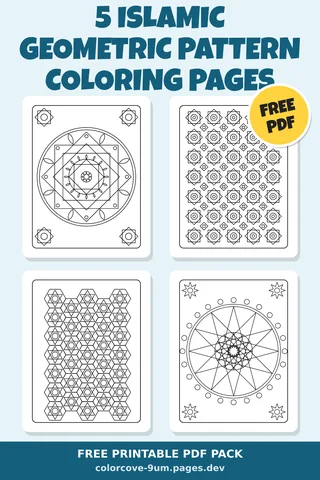
Islamic geometric pattern coloring pages inspired by traditional star tilings: an 8-point Rub el Hizb medallion, 8-fold star tiles, hexagonal star patterns, a 12-point rosette and a Ramadan lantern. Click any page for a large preview, or tick Add to bundle to download several pages as one PDF (A4 or US Letter).
Download all 5 islamic geometric pattern pages in one PDF
One file, every page in this topic plus a contents page — print the whole set at once. Free for personal & classroom use.
16 KB (Letter) · 16 KB (A4) · 6 pages incl. contents page
How to use these islamic geometric pattern coloring pages
Islamic geometric patterns are built from stars and polygons that interlock and repeat. The trick to coloring them is to pick out one shape family first, for example every 8-point star, color all of those, then move to the shapes between them. The pattern "appears" as you go, which is very satisfying.
These pages work as an art activity, a geometry lesson (symmetry, rotation, angles) and a calm activity during Ramadan. They are inspired by traditional star tilings and drawn precisely with code, so the lines are even and the symmetry is exact.
Step by step: coloring a islamic geometric pattern page
- Find the largest stars in the pattern and color all of them first, in your main color.
- Color the shapes that touch the stars (often small kites or pentagons) in a second color.
- Fill the remaining background shapes in a third, lighter color.
- Step back. If the pattern looks busy, darken one color family to bring the stars forward.
Which pages suit which age?
- Ages 5–12
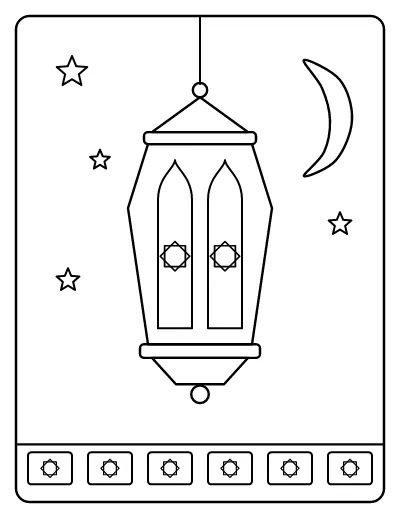
- Ramadan Lantern with Crescent Moon is the friendliest starting point: larger shapes with a familiar object.
- Ages 8+
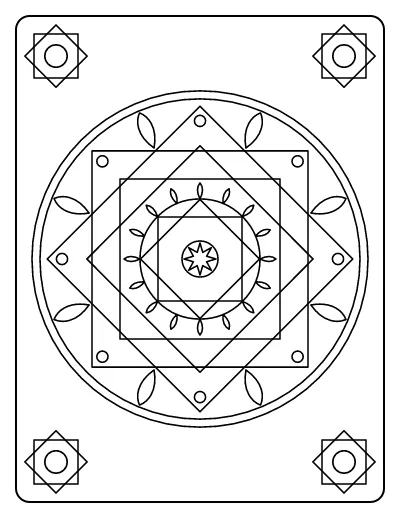
- Rub el Hizb 8-Point Star Medallion has a clear central star to color first, then the surrounding bands.
- Teens and adults
- Eight-Point Star Tile Pattern, Hexagon Star Pattern and Twelve-Point Star Rosette are dense tilings for colored pencils or fine markers and plenty of patience.
Printing tips
- The tile patterns have many small spaces. Print the PDF for the sharpest lines, and use a sharp pencil or fine-tip markers.
- Print two copies of a tiling to try different color schemes; it is amazing how different the same pattern looks.
- Heavier paper (120 gsm+) helps if you use markers on the detailed tilings.
- Choose A4 outside North America and US Letter in the US and Canada. Both PDFs keep safe margins.
Coloring ideas & activities
- Traditional palette: try deep blue, turquoise, white and a touch of gold or yellow, colors often seen in tilework.
- Find the symmetry: ask students to count how many times a pattern repeats around a center (8 or 12) and mark the lines of symmetry.
- Ramadan decorations: color, cut out the lantern or medallion and hang them as decorations, or glue them on card for Eid greetings.
- Compare with mandalas: discuss how both use radial symmetry, and how tilings repeat across the page as well as around a point.
- Tile wall: color several copies of a tile pattern, cut them into squares and arrange them into a large class mosaic.
- Compass challenge: older students can try to draw an 8-point star with a compass and ruler after coloring one.
What kids practice with these pages
These pages connect art and math: angles, polygons, symmetry and tessellation. Older students can measure angles at the star points or try to continue a tiling on squared paper.
Every page in this collection
- Rub el Hizb 8-Point Star Medallion: Nested 8-point stars (Rub el Hizb) inside a circular medallion with petal and star corners.
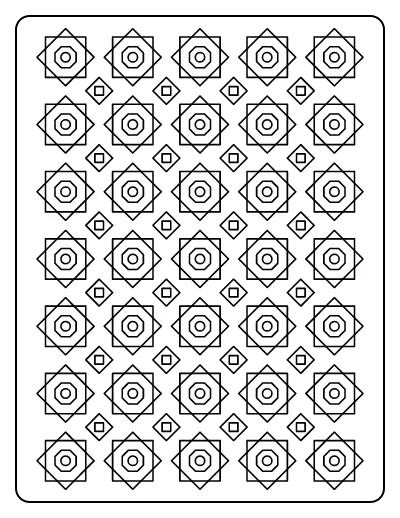
- Eight-Point Star Tile Pattern: A repeating tile of 8-point stars, octagons and diamonds — color by repeating shape.
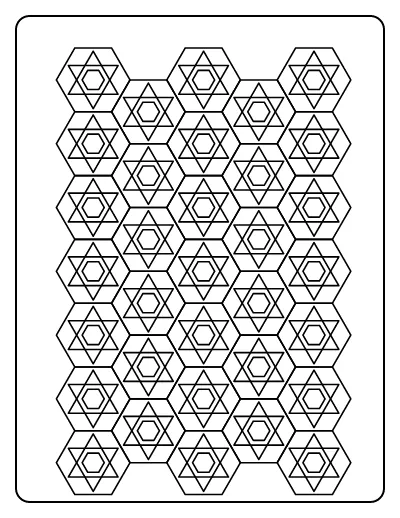
- Hexagon Star Pattern: Six-point stars inside hexagons form a honeycomb-like geometric pattern.
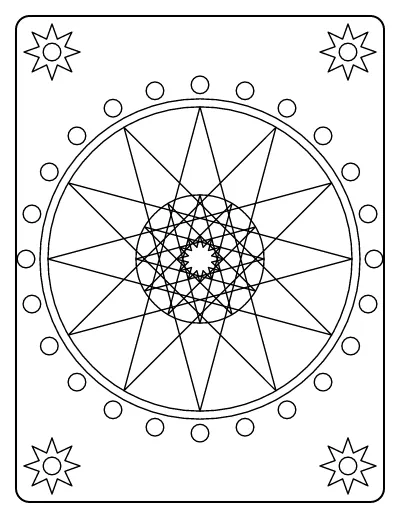
- Twelve-Point Star Rosette: An interlaced 12-point star rosette with a beaded border and star corners.
- Ramadan Lantern with Crescent Moon: A traditional lantern (fanous) with star windows, a crescent moon and a geometric tile border.
Fun facts to share while you color
- Geometric patterns became a major feature of Islamic art, appearing in tilework, wood, stucco and metalwork from Spain to Central Asia.
- Many patterns can be drawn using only a compass and straightedge: a few circles and lines create the whole grid.
- The Rub el Hizb, an 8-point star made from two overlapping squares, is used in the Qur'an to mark sections for recitation.
- Buildings like the Alhambra in Granada are famous for their geometric tile and stucco patterns.
- The 8-point star made from two overlapping squares appears widely in Islamic architecture, from Morocco to Iran.
- Some medieval Islamic tile patterns have properties similar to quasicrystal patterns that mathematicians described only in the 20th century.
Islamic Geometric Pattern coloring pages FAQ
Are these suitable for Ramadan and Eid activities?
Yes — the lantern (fanous) and star patterns are popular for Ramadan, Eid and Islamic art lessons.
How can I teach geometry with these?
Ask children to count the points of each star, find the squares and hexagons, and color repeating shapes with the same color.
Do these pages contain any religious text?
No. They are geometric patterns and a lantern design without calligraphy, so they can be used in any classroom.
Are there more Ramadan pages?
Yes. See the Ramadan & Eid collection for lanterns, a mosque at night, an iftar table and Eid gifts.
What tools work best for these patterns?
Sharp colored pencils or fine-tip markers are ideal for the detailed tilings. A ruler can help you keep straight edges neat.
Are these designs copied from real buildings?
They are inspired by traditional star patterns found across Islamic art and architecture, but drawn as original designs with code rather than copied from a specific building.